Porosity is the ability of your hair to absorb and retain moisture. It is determined by the structure of your cuticle or the outer layer of your hair.
Read time : min
Read time : min
You saw a good combo deal on a branded shampoo and conditioner online. You went ahead and made the purchase. But your hair felt dry and rough after the first application. Sounds familiar? Here’s what you needed to know about your hair- its porosity.
Porosity is the ability of your hair to absorb and retain moisture. It is determined by the structure of your cuticle or the outer layer of your hair. It is mostly genetic but can be altered by heat and chemical exposure. Knowing your hair’s porosity is useful to choose the right products that would keep your tresses well-maintained and moisturized.
Let’s understand this in detail.

There are three ways to determine the porosity of your hair:
Take some strands of your hair from your comb and drop them into a bowl of water. Allow them to sit for 2-3 minutes. Now notice whether your hair floats or sinks. You have a low porosity if your hair floats and a high porosity if your hair sinks.
Slide a hair strand from the tip up towards the scalp using your index finger and thumb. If you feel little bumps along the way, you have a high porosity. If the slide is smooth, you have a low porosity. If you felt the slide was normal, you have a normal porosity.
Spritz a small section of your hair with water. Did the water droplets form beads on your hair? If so, you have a low hair porosity. Did the water get absorbed quickly? This means you have high hair porosity. But if the water gets absorbed after some time, your hair has a normal porosity.
The three tests help categorize the porosity of your hair into three types: High, Low, and Normal. Let’s explore them further.
High
| Hair Characteristics | Hair Care |
| Absorbs water easily | Use minimal heat. Let your hair dry naturally. |
| Looks dry and frizzy | Rinse with cold water |
| Dries quickly | Include Amrutam Kuntal Care Hair Spa for deep hair nourishment |
Low
| Hair Characteristics | Hair Care |
| Least absorption or penetration | Use heat to help hair products gets absorbed better and bind with your hair |
| Takes a long time to dry | Apply products on damp hair only |
| Products make the hair oily or greasy | Evenly distribute the product throughout the hair |
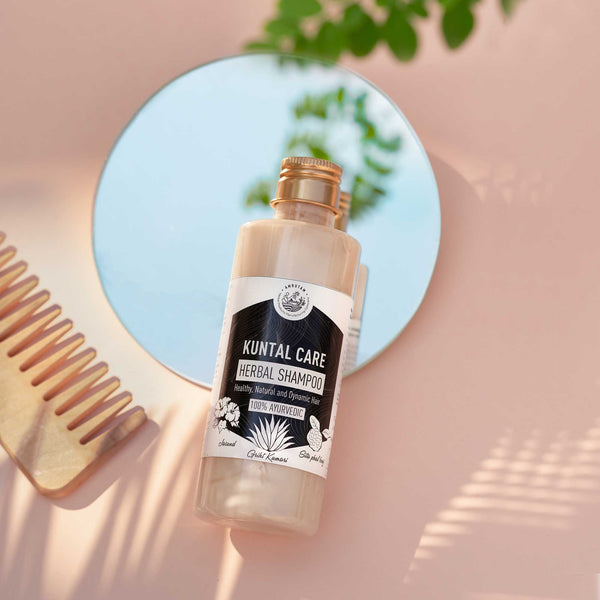
| Use Kuntal Care Herbal Shampoo to remove any product built up |
Normal
| Hair Characteristics | Hair Care |
| Accepts and holds moisture | Just needs deep conditioning. You could also have Kuntal Care Malt as a supplement. |
| Require less maintenance | Avoid exposing your hair to chemical treatments frequently to prevent hair fall and damage. |
| Bouncy and elastic | |
| Holds style and colors well |
Once you know the porosity of your hair, you will be able to create an effective hair care regime. Doing so can enable you to treat several hair care issues, such as hair fall, breakage, and dullness. Do write to us if you have any doubts about hair porosity.
References
https://www.stylecraze.com/articles/everything-about-hair-porosity/#gref
https://www.naturallycurly.com/texture-typing/hair-porosity
https://www.ouidad.com/blog/curly-hair-routine-101/all-about-porosity

Ubtan for sensitive skin calls for fine powders, short contact time, and no scrubbing. Patch-test first to gently reduce redness and irritation.

Ubtan vs face scrub differs in texture and technique. Compare particle size and practical guidance for sensitive, dry, oily, and acne-prone skin types.

Hair spa before or after heat styling? Get clear timing, heat-protection, and recovery tips for smoother, better-conditioned hair between salon visits.

Aloe vera gel as a makeup primer offers lightweight hydration. See how to layer it, prevent pilling, and pair it with the right foundation for your skin.

Ubtan before makeup works best 2-3 hours ahead for most skin types; get skin-specific timing and prep tips for a smooth foundation base without irritation.

Know when to wash hair before a festival: timing for oily, dry, and curly hair, plus prep for braids, blowouts, and heat styling for polished festive styling.

Use ubtan with active ingredients more carefully: space retinol, acids, and vitamin C apart, watch for irritation, and protect your skin barrier each day.

Ayurvedic malt for women: clear facts on safety, PCOS claims, ingredients, and weight concerns, with practical guidance for informed use.
Imbalances are unique to each person and require customised treatment plans to curb the issue from the root cause fully. Book your consultation - download our app now!