Read time : min
According to ayurveda, your hair type will be in accordance with your constitution (Dosha). Your constitution is a unique combination of the doshas, vata, pitta & kapha. Because of these unique attributes, everyone’s haircare will be different.
Your hair type will be perhaps one or a mixture of the following characteristics:
Vata:
Vata type hair is thin, sometimes wiry or frizzy and has a tendency towards curliness and/or dryness. The scalp is dry and this sometimes causes itchiness and dandruff.
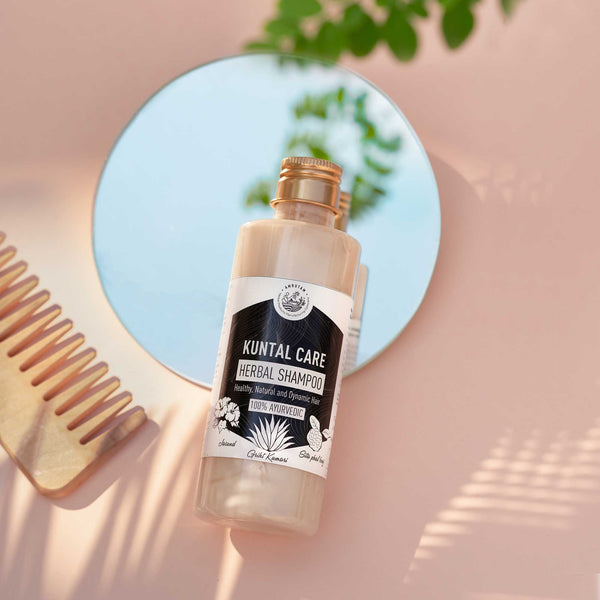
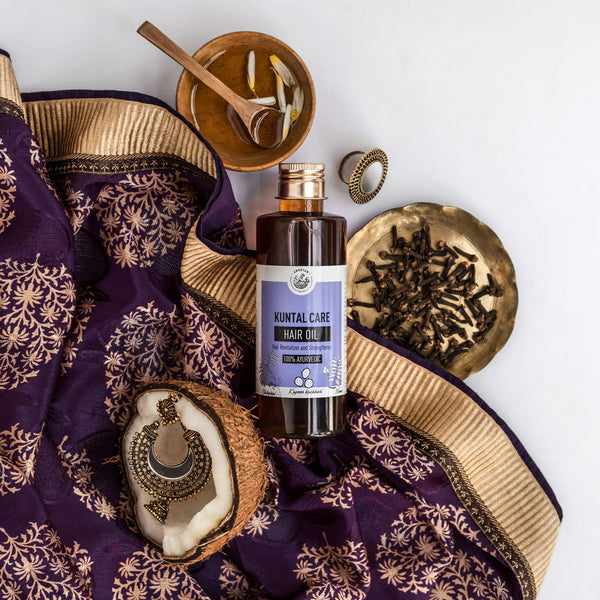
Vata type hair requires nourishment. For this, I would recommend washing your hair less frequently to allow the natural oils to form on the scalp. To tame the dryness and curliness, regular warm oil treatments are beneficial. Conditioning the hair is not always a good idea, for it does not much more than provide an oily film that traps dirt and makes the hair look dull. It is better to use a good shampoo with ayurvedic extracts such as the kuntal hair care herbal shampoo. After washing, you can towel dry the hair and use a small amount of oil on the ends. For a deeper treatment you can use this oil in a warm oil head massage and then leave on the hair over night. Rinsing off the following morning and washing with a gentle shampoo.

Ingredients to favour:
Almond, coconut, jojoba & argan oil
Tip for vata type hair:
Oil your hair and tie it hair up if you are heading out in windy or hot weather. This will protect it from further dryness. You can make this look nice with a sleek topknot bun or a smart low bun/ponytail with a side parting. Add a few drops of your favourite essential oil to the oil of choice if you are worried about strong smelling oil!
Pitta:
Pitta type hair is more oily. It is normally straight and sleek in nature and has a lustrous colour. However, early balding and greying is more prominent in these types.
Pitta type of hair requires cooling down the scalp and de-greasing. Washing the hair daily or every other day is recommended if the oiliness is quite prominent. If this is performed with a quality shampoo and regular scalp oil treatments with ingredients such as neem and amla then the oiliness should be kept at bay as well as a having a cooling effect on the head. This will help in preventing hair loss and premature greying.
Tip for pitta type hair:
Regularly wash with a cleansing shampoo. Avoid heavy ingredients with a creamy quality. Choose cooling and refreshing hair care. It is very important that the head is covered in places of direct sunlight as this will help immensely in preventing hair loss and premature greying. Also think about rinsing the hair with cool water instead of hot.
Ingredients to favour:
Mint, neem & coconut

Kapha:
Kapha type hair is very thick, shiny, smooth, lustrous and well nourished. However, it can have a tendency towards dullness when kapha is out of balance.
Kapha type hair will benefit from stimulating scalp treatments. This will counteract the heaviness and create a light feeing. Opt for light shampoos, but not necessarily cooling. Lemon is an excellent ingredient for kapha type hair. The hair need not be washed so regularly in kapha types, but when it is washed, the use of a light oil or serum is recommend to seal in the shiny and smooth quality.
Tip for kapha type hair:
When you are out, wear the hair loose. This will allow air to circulate through the scalp and prevent a build up of grease and dirt. Regular head massage is beneficial for kapha types to create stimulation and blood flow.
Ingredients to favour:
Lemon, lemongrass & lime
In general, vata dosha is cold in nature and so this causes less nourishment in the scalp. Pitta type hair has a tendency towards a hot scalp and so hair loss is common. Kapha type hair is generally healthy but when out of balance may cause the hair to be heavy and dull.
_______________________________________________________________________________
About the Author
Naina Bajaria is an Ayurvedic Practitioner, Pharmacist and a Yogi.
She is also a wonderful blogger and vlogger.
You can check out her latest vlog here.
[embed]https://www.youtube.com/watch?v=Dbv078aHlaM[/embed]